The Hidden Grain
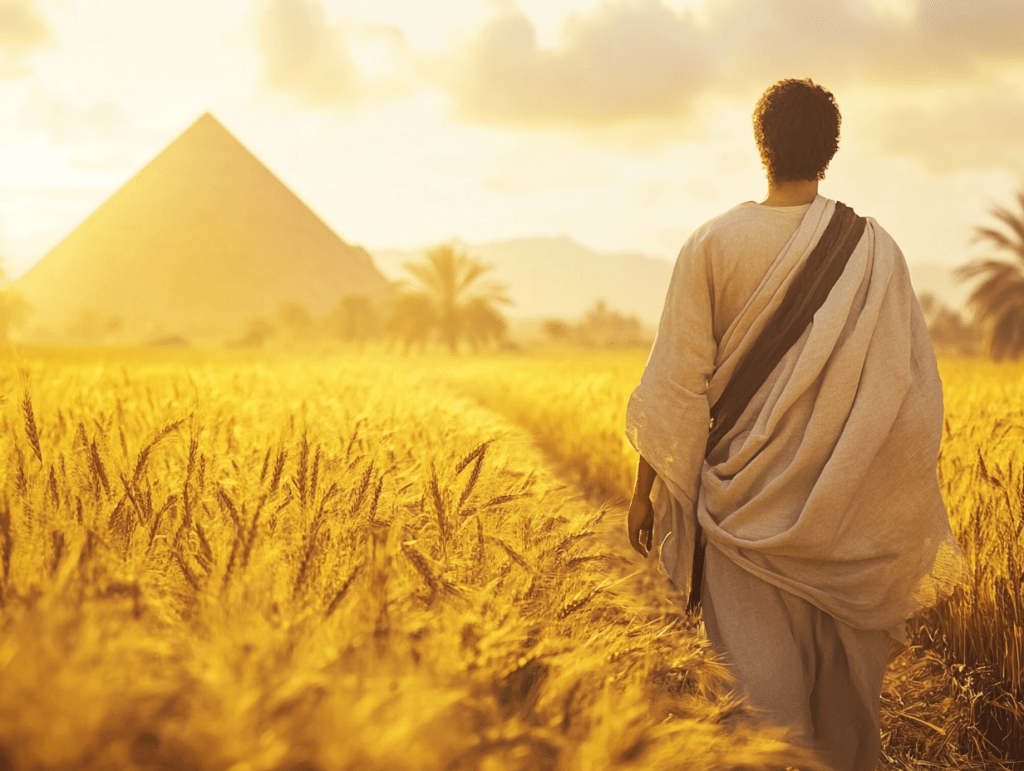
Joseph’s provision (Genesis 45:7, “God sent me before you to preserve for you a remnant on earth, and to keep alive for you many survivors”) saved Israel during famine, a remarkable act of divine foresight. Yet, this is more than a survival tale—it’s a Sod (סוֹד, Strong’s H5475: “hidden secret” or “council”), a mystery embedded in Scripture, pointing to the Kingdom of Heaven’s bounty (Revelation 20:6, “they will reign with him for a thousand years”). Joseph’s grain ensured physical provision, but its deeper meaning unveils a future hope: the abundance of Christ’s millennial kingdom, where the saints inherit the earth (Matthew 25:34, “inherit the kingdom prepared for you”). This hidden depth, uncovered through Dual-Realm Dispensationalism, transforms a historical narrative into a prophetic signpost, revealing God’s layered plan.
Dual-Realm Revelation
The Kingdom of God (ἡ βασιλεία τοῦ Θεοῦ, Colossians 1:13, “transferred us to the kingdom of his beloved Son”) is a spiritual reality, entered now by faith—a realm where believers experience grace (Ephesians 2:8, “by grace you have been saved through faith”). This is the Church Age, where the gospel transforms lives across all nations (Matthew 28:19, “make disciples of all nations”). In contrast, the Kingdom of Heaven (ἡ βασιλεία τῶν οὐρανῶν, Matthew 5:3, “theirs is the kingdom of heaven”) awaits Christ’s physical reign after the Rapture and Tribulation, a kingdom where His rule is tangible (Revelation 20:4, “they came to life and reigned with Christ for a thousand years”). Joseph’s grain bridges these realms: his provision sustains God’s people now (Kingdom of God), while his story foreshadows their future inheritance (Kingdom of Heaven). Dual-Realm Dispensationalism, rooted in a literal hermeneutic (2 Timothy 2:15, “rightly handling the word of truth”), reveals this divine duality, challenging conflationist views that blur the distinction between these kingdoms.
Arnold Fruchtenbaum, in Israelology: The Missing Link in Systematic Theology, emphasizes that such distinctions are critical. He argues that Israel’s role in God’s plan—past, present, and future—cannot be conflated with the Church’s, a principle that applies here. The Kingdom of God operates now through the Church, but the Kingdom of Heaven awaits Israel’s restoration, a future where Joseph’s legacy of provision finds its ultimate fulfillment. Fruchtenbaum’s dispensational lens highlights this separation, ensuring we don’t spiritualize away the physical promises to Israel (Romans 11:29, “the gifts and the calling of God are irrevocable”).
Joseph’s Dreams: A Prophetic Window
Joseph’s dreams (Genesis 37:7, “your sheaves gathered around and bowed down to my sheaf”) are more than sibling rivalry—they’re a Sod unveiled. The bowing sheaves prefigure his rise to power (Genesis 41:41, “he made him ruler over… all the land of Egypt”), mirroring Christ’s future reign. Charles Ryrie notes, “Prophetic types in the Old Testament often point to New Testament fulfillments” (Dispensationalism, 2007). This aligns with Daniel 7:27’s “the saints of the Most High shall receive the kingdom”, a Kingdom of Heaven promise. The dream’s imagery—grain, authority—echoes Revelation 20:4, where saints reign with Christ. Joseph’s second dream (Genesis 37:9, “the sun, the moon, and eleven stars were bowing down to me”) extends this, showing his family’s submission, a type of Israel’s future under Messiah (Zechariah 14:9, “the Lord will be king over all the earth”). These dreams, when viewed through a dual-realm lens, reveal God’s plan for both spiritual provision now and physical rulership later.
Fruchtenbaum’s work underscores the importance of such typological interpretation. He argues that Israel’s history is replete with patterns (Israelology, 1989), like Joseph’s life, that point to future eschatological realities. This method avoids allegorizing scripture, instead letting the text speak literally—a cornerstone of dispensational theology.
Historical Context and Spiritual Insight
In ancient Egypt, grain was life—Joseph’s stewardship (Genesis 47:14, “Joseph gathered up all the money… and brought it into Pharaoh’s house”) ensured survival, a type of the Kingdom of God’s provision. His elevation at age thirty (Genesis 41:46, “Joseph was thirty years old when he entered the service of Pharaoh”) hints at the Kingdom of Heaven’s rulership, mirroring Christ’s public ministry beginning at thirty (Luke 3:23). Historians like Kenneth Kitchen (On the Reliability of the Old Testament, 2003) affirm Egypt’s grain economy, noting its role in sustaining the region during famines, supporting this typology. The seven years of plenty and famine (Genesis 41:29-30) also parallel prophetic cycles—seven years of Tribulation (Daniel 9:27) precede the Kingdom of Heaven’s abundance.
Spiritually, Joseph’s faithfulness (Genesis 39:9, “how then can I do this great wickedness and sin against God?”) reflects the Kingdom of God’s call to righteousness (Romans 6:13, “yield yourselves to God”). His authority over Egypt foreshadows the Kingdom of Heaven’s rule, where Christ’s dominion is universal (Revelation 11:15, “the kingdom of the world has become the kingdom of our Lord”). Dual-Realm Dispensationalism sees this not as allegory but as literal foreshadowing—every detail a thread in God’s tapestry.
The Rapture’s Bridge
Joseph’s story bridges the realms—his preservation now (Kingdom of God) and his reign later (Kingdom of Heaven) parallel the Rapture. 1 Thessalonians 4:17 (“caught up together… to meet the Lord in the air”) separates the Church Age from the Tribulation, leading to the millennial kingdom. Joseph’s ascent from prison to power (Genesis 41:14, “they brought him quickly out of the dungeon”) mirrors this transition—a sudden elevation after suffering, much like the Church’s rapture before the Tribulation (Revelation 3:10, “I will keep you from the hour of trial”). Fruchtenbaum notes that dispensationalism’s strength lies in maintaining such distinctions (Israelology, 1989), ensuring the Rapture isn’t conflated with the Second Coming, a key dual-realm insight.
This bridge also ties to Israel’s future. Joseph’s reconciliation with his brothers (Genesis 45:4, “I am your brother, Joseph, whom you sold into Egypt”) prefigures Israel’s restoration (Romans 11:26, “all Israel will be saved”). The grain he stored becomes a type of provision during the Tribulation, where Israel endures until Christ’s return (Zechariah 12:10, “they will look on me, on him whom they have pierced”). More essays will explore this Sod, revealing how the Rapture unlocks the dual-realm mystery.
More to Uncover
This exploration merely opens the door. Dual-Realm Dispensationalism invites us into Scripture’s deeper meanings—grace now, glory later (1 Corinthians 3:11-15, “each one’s work will be revealed by fire”). Upcoming essays will delve into Joseph’s dreams’ prophetic layers, Matthew’s parables (Matthew 13:44, “the kingdom of heaven is like treasure hidden in a field”), and the Rapture’s timing, each a Sod (סוֹד, Strong’s H5475: hidden secret) of God’s Word. We’ll explore how Joseph’s life intersects with Israel’s covenants (Genesis 15:18, “to your offspring I give this land”), a theme Fruchtenbaum highlights as central to dispensational theology. Stay tuned—every verse holds a treasure (2 Timothy 3:16, “All Scripture is breathed out by God”), waiting to be uncovered by faith.
 Refined By Fire
Leave a comment