Introduction
Middle East tensions grip the headlines—nations align, and conflicts flare. Could these events signal the plundering invasion of Israel foretold in Ezekiel 38, where Gog of Magog leads a coalition to seize spoil from God’s people? Scripture’s literal truth guides my view: Ezekiel 36-39 unveils a future restoration of Israel’s twelve tribes and a unique attack during a deceptive peace. For Christians and Jews seeking answers, this article dives into Ezekiel’s prophecy, backed by scripture, to discern if today’s unrest fulfills Ezekiel 38 or merely hints at its approach. Like the men of Issachar, who “understood the times” (1 Chronicles 12:32), we must examine the signs and stay vigilant.
Ezekiel 36-37: Israel’s Restoration as Foundation
God’s plan for Israel begins with restoration. Ezekiel 36:24-28 promises that God will gather His people from all nations, cleanse them, give them a new heart, and place His Spirit within them. This is no metaphor—it’s a literal regathering of Israel’s twelve tribes to their land. Just as Jesus assures in John 10:28-29 that no one can snatch His sheep from His hand, God’s immutable promises guarantee Israel’s restoration, secure in His unyielding grip. Ezekiel 37:1-14’s Valley of Dry Bones vividly portrays this: scattered bones, symbolizing Israel’s exiled tribes, are revived into a living nation. Ezekiel 37:15-23 reinforces this: two sticks, representing Judah (southern tribes) and Israel/Ephraim (northern tribes), unite under one king. Scripture confirms: Deuteronomy 30:3-5 vows to restore Israel from dispersion; Isaiah 11:11-13 foretells Judah and Ephraim’s reunion; Romans 11:25-26 declares “all Israel will be saved” after the Gentile fullness.
The Tribe of Dan, omitted in Revelation 7’s 144,000, is included in Ezekiel 48:1-2’s millennial land division, proving their temporary exclusion. J. Dwight Pentecost, in Things to Come, writes, “The regathering of Israel, including all tribes, is a literal prerequisite for the events of Ezekiel 38-39.” Today’s Israel, primarily descendants of Judah, Benjamin, and Levi (post-Babylonian exile, Ezra 1:5), lacks the northern tribes, scattered since Assyria’s conquest (2 Kings 17:6). This partial regathering is a shadow of Ezekiel’s restored nation, setting the prophetic stage.
Ezekiel 38-39: The Gog-Magog Invasion
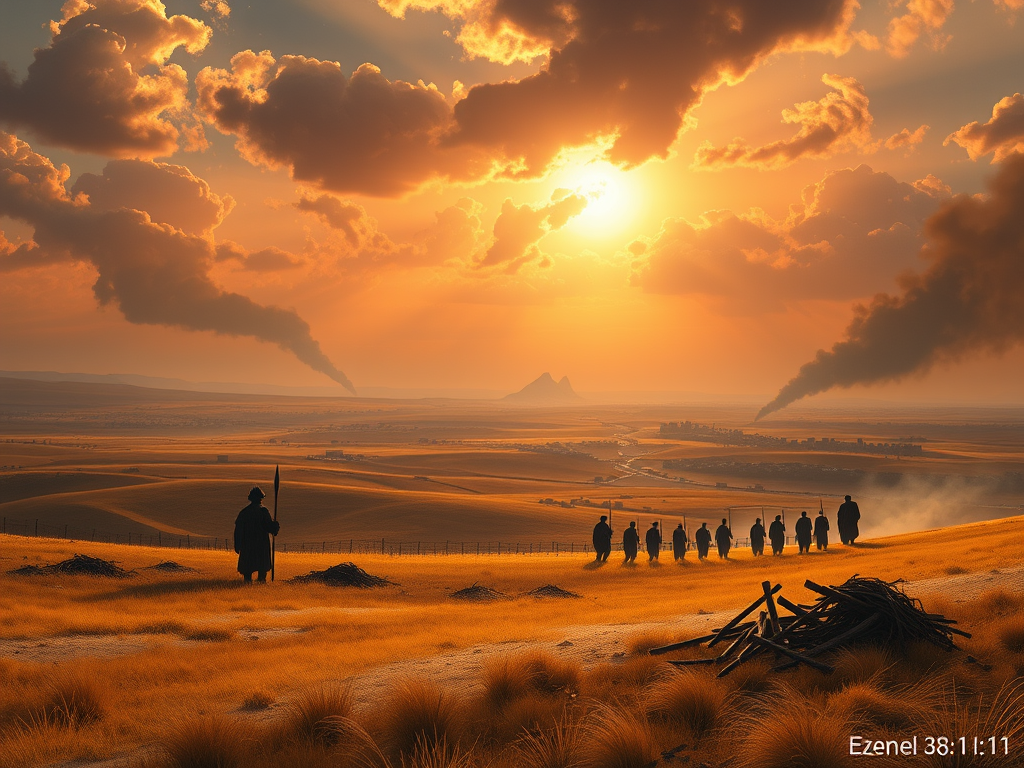
Ezekiel 38:1-6 introduces Gog, of Magog (often linked to Russia), leading a coalition: Persia (Iran), Cush (Sudan), Put (Libya), Gomer, and Togarmah (Turkey). Ezekiel 38:10-11 reveals Gog’s motive: he attacks a peaceful Israel, dwelling in “unwalled villages” without “bars or gates,” secure and unsuspecting. Ezekiel 39:9 describes Israel burning invaders’ weapons for seven years, pointing to Tribulation timing. God destroys the attackers with earthquakes, pestilence, and fire (Ezekiel 38:19-23).
Yashab betach (Hebrew) implies dwelling in covenantal security, pointing to a false peace under the Antichrist’s covenant (Daniel 9:27).
Scripture supports this: Daniel 9:27 hints at a false peace, broken mid-Tribulation. Zechariah 12:9 echoes God’s defense of Israel. Revelation 20:7-9 distinguishes Ezekiel 38 from a post-millennial Gog-Magog event. John F. Walvoord, in The Prophecy Knowledge Handbook, states, “Ezekiel 38 describes a unique invasion during a period of false peace, distinct from current Middle East conflicts.”
Today’s Israel, with fortified borders, Iron Dome, and vigilance, contradicts Ezekiel 38:11’s “unwalled villages.” While Russia, Iran, and Turkey show alliances (e.g., Syria support), the full coalition, including Sudan and Libya, isn’t unified against Israel in the 2025 context. Ezekiel 38 awaits a distinct moment.
The Tribulation: Israel’s Jewish Destiny and Ezekiel 38 Timing
The Tribulation, a seven-year crucible for Israel, is distinctly Jewish. Jeremiah 30:7 calls it “Jacob’s trouble,” yet Israel is saved. Revelation 12:13-17 shows Israel persecuted by Satan but protected for 3.5 years. Matthew 24:15-21 warns of the “abomination of desolation” (Daniel 9:27), urging Judean flight mid-Tribulation.
Israel’s state shifts: the first 3.5 years bring false peace via the Antichrist’s covenant (Daniel 9:27), enabling temple worship (2 Thessalonians 2:4). Israel, lulled into security, matches Ezekiel 38:11’s “secure” state. The second 3.5 years bring betrayal, temple desecration, and persecution, with a remnant preserved (Zechariah 13:8-9).
Ezekiel 38 fits post-Rapture, likely early Tribulation. The Rapture (1 Thessalonians 4:16-17) shifts focus to Israel (Romans 11:25). The Antichrist’s covenant creates Ezekiel 38:11’s peace. The seven-year weapon cleanup (Ezekiel 39:9) aligns with the Tribulation, as Israel burns Gog’s arsenal. Arnold G. Fruchtenbaum, in Israelology, notes, “Ezekiel 38 occurs post-Rapture, when Israel’s regathered state and Antichrist’s covenant create a deceptive peace.” Chuck Missler, in Prophecy 20/20, adds, “The seven-year cleanup anchors Ezekiel 38 within the Tribulation’s timeline, distinct from today’s conflicts.”
Current Israel’s military readiness precludes Ezekiel 38’s “unwalled” state. Only a post-Rapture peace sets the stage.
Current Events as Signs of the Times
The world in 2025 is prophetically significant—wars, moral decay, and unrest abound. Yet these don’t fulfill Ezekiel 38. Israel’s fortified state contradicts “unwalled villages.” The Gog-led coalition—potentially Russia (Magog), Iran (Persia), Turkey (Gomer/Togarmah), Sudan (Cush), Libya (Put)—shows partial alignment (e.g., Russia-Iran-Turkey ties in Syria), but lacks the unified, massive assault of Ezekiel 38:9 (“like a cloud covering the land”).2 The full regathering of all tribes (Ezekiel 37) remains incomplete, as modern Israel primarily reflects Judah, Benjamin, and Levi.
2 Recent reports note Russia, Iran, and Turkey’s cooperation in Syria, but Sudan and Libya’s instability limits their role in a cohesive coalition today.
These events are “signs of the times.” Matthew 24:6-8 describes wars as “birth pains.” 2 Timothy 3:1-5 warns of last-days godlessness. Luke 21:28 urges believers to look up, as redemption nears. Charles C. Ryrie, in Ryrie Study Bible, writes, “Current conflicts are precursors, pointing to the nearness of prophetic fulfillment, but Ezekiel 38 awaits a unique peace.”
Like Issachar, who “understood the times and knew what Israel ought to do” (1 Chronicles 12:32), we must be vigilant. Study prophecy like Bereans (Acts 17:11). Pray for Israel’s restoration (Psalm 122:6). Share the gospel urgently (Matthew 24:14). Live holy, expecting Christ’s return (Titus 2:13). Jack Hibbs, in Happening Now, exhorts, “The signs are clear—wake up, watch, and work for the kingdom while time remains.”
Conclusion
Ezekiel 36-39 unveils God’s plan: Israel’s twelve tribes, including Dan, will be regathered (Ezekiel 36-37), and Gog will invade a peaceful Israel post-Rapture (Ezekiel 38:10-11). Current events don’t match this prophecy—Israel’s defenses, partial regathering, and incomplete coalition prove it. Yet they signal prophecy’s approach as “signs of the times.” As Issachar’s heirs, we must discern, study scripture, pray, evangelize, and await Christ’s return. Matthew 24:42 commands, “Stay awake, for you do not know on what day your Lord is coming.”
 Refined By Fire
Leave a comment