Introduction
Our journey through Refined by Fire has shown us the transformative power of faith (Post 8) and the sacrificial works required to seek the Kingdom (Post 9). Now, we continue in Part 2: Spirit-Led Works in This Age, turning to the Parable of the Good Samaritan (Luke 10:25-37), a timeless lesson on love as a Spirit-led work that endures. Jesus shared this parable in response to a lawyer’s question about eternal life, revealing that love for God and neighbor is the heart of Kingdom works. As we explore this story, we’ll see how acts of compassion in the Kingdom of God now prepare us for the glory of the Kingdom of Heaven, fulfilling the call to love in action.
The Call to Love Your Neighbor
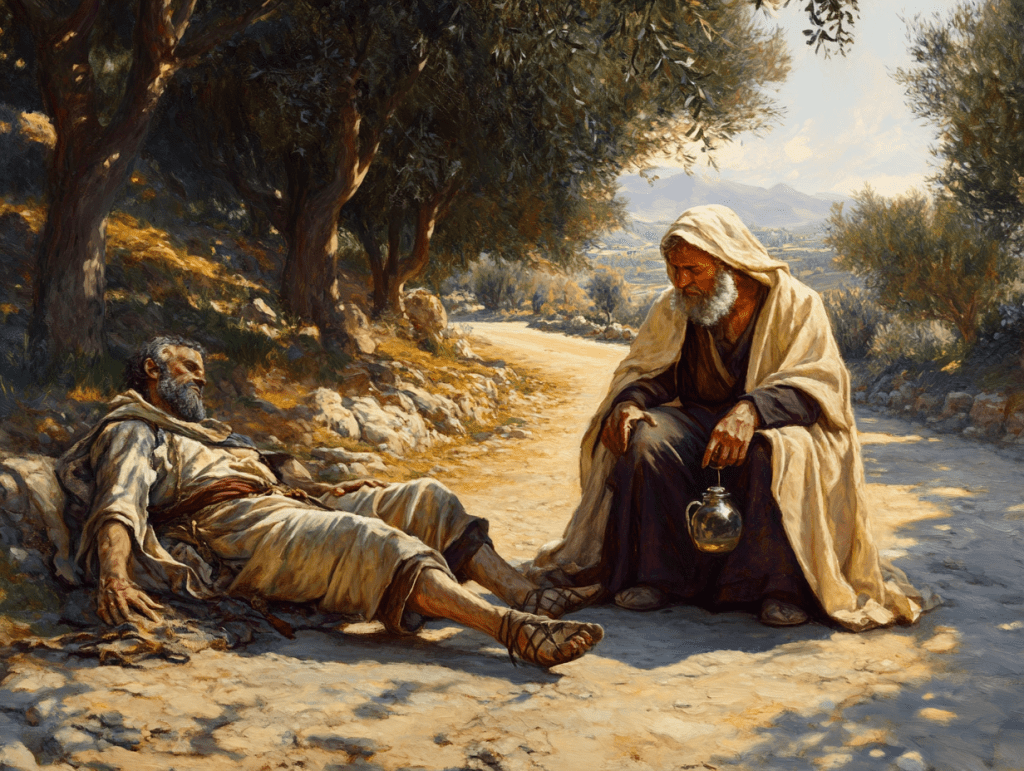
In the 1st-century Judean setting of Luke 10, Jesus was teaching a crowd when a lawyer asked, “Teacher, what shall I do to inherit eternal life?” (Luke 10:25, ESV). Jesus pointed him to the law: love God and love your neighbor (Luke 10:27). When the lawyer asked, “And who is my neighbor?” (Luke 10:29), Jesus responded with the Parable of the Good Samaritan: A man traveling from Jerusalem to Jericho was attacked by robbers, left half-dead. A priest and a Levite passed by, but a Samaritan stopped, bandaged his wounds, and cared for him (Luke 10:30-35). In this context, Samaritans were despised by Jews due to historical and religious tensions (John 4:9), making the Samaritan’s compassion radical. Jesus concluded, “You go, and do likewise” (Luke 10:37, ESV), showing that love transcends boundaries and is the essence of Kingdom works. This aligns with Dual-Realm Dispensationalism, where love in the Kingdom of God now (Colossians 1:13) prepares us for the Kingdom of Heaven (Revelation 22:12). J. Dwight Pentecost writes, “The Good Samaritan exemplifies the love that marks Kingdom works, a love that endures the Bema Seat’s fire” (Things to Come, 1958, p. 145).1 The parable calls us to love our neighbor as a Spirit-led work, reflecting the Kingdom’s heart.
The Samaritan’s Compassionate Works
The Samaritan’s actions—bandaging wounds, providing oil and wine, and ensuring the man’s care—represent Spirit-led works of love that endure. On the Jericho road, a dangerous 17-mile stretch descending 3,000 feet from Jerusalem to Jericho, the Samaritan risked his safety to help a stranger. His compassion stood in stark contrast to the priest and Levite, who prioritized ritual purity over mercy. 1 Corinthians 13:13 declares, “So now faith, hope, and love abide, these three; but the greatest of these is love” (ESV). The Samaritan’s love was active, costly, and selfless, embodying the Spirit-led works that prepare us for the Kingdom of Heaven. In the 1st-century context, his actions were revolutionary, crossing cultural divides to show mercy. H.A. Ironside reflects, “The Samaritan’s love mirrors the heart of Christ, a love that acts without hesitation” (Luke, 1915, p. 89).2 His compassionate works challenge us to love actively, even when it’s inconvenient or costly, as a reflection of the Kingdom’s values.
Practical Application: Loving in Action
The Parable of the Good Samaritan calls us to love in action, showing compassion to those in need as a Spirit-led work. In our modern context, this means looking for opportunities to serve others, even when it’s inconvenient. Galatians 6:10 urges, “So then, as we have opportunity, let us do good to everyone, and especially to those who are of the household of faith” (ESV). Practically, this might look like helping a neighbor with groceries, offering a listening ear to a friend in distress, or supporting a local charity with your time or resources. For example, taking time to visit a sick relative or donating to a food bank can be acts of love that reflect the Kingdom’s heart. John Walvoord notes, “Love in action is the hallmark of Kingdom works, preparing us for eternal glory” (The Bible Knowledge Commentary, 1983, p. 234).3 Love in action—show compassion to others, building works that endure.
More to Explore
The Good Samaritan challenges us to love in action, reflecting the Kingdom’s heart. Our next post will explore readiness (Matthew 24:45-47) in the Kingdom of God now, preparing us for glory in the Kingdom of Heaven. Stay tuned—God’s Word holds treasures (2 Timothy 3:16), and for a deeper dive, look forward to Refined by Fire, a forthcoming book exploring these truths across 24 chapters, deepening your journey in the Kingdom of God and Heaven (Ephesians 2:10).
Endnotes
- J. Dwight Pentecost, Things to Come (Grand Rapids: Zondervan, 1958), 142.
- H.A. Ironside, Expository Notes on the Gospel of Matthew (Neptune, NJ: Loizeaux Brothers, 1920), 146.
- Norman Geisler, Systematic Theology (Minneapolis: Bethany House, 2002), 683.
 Refined By Fire